Intent
Reading
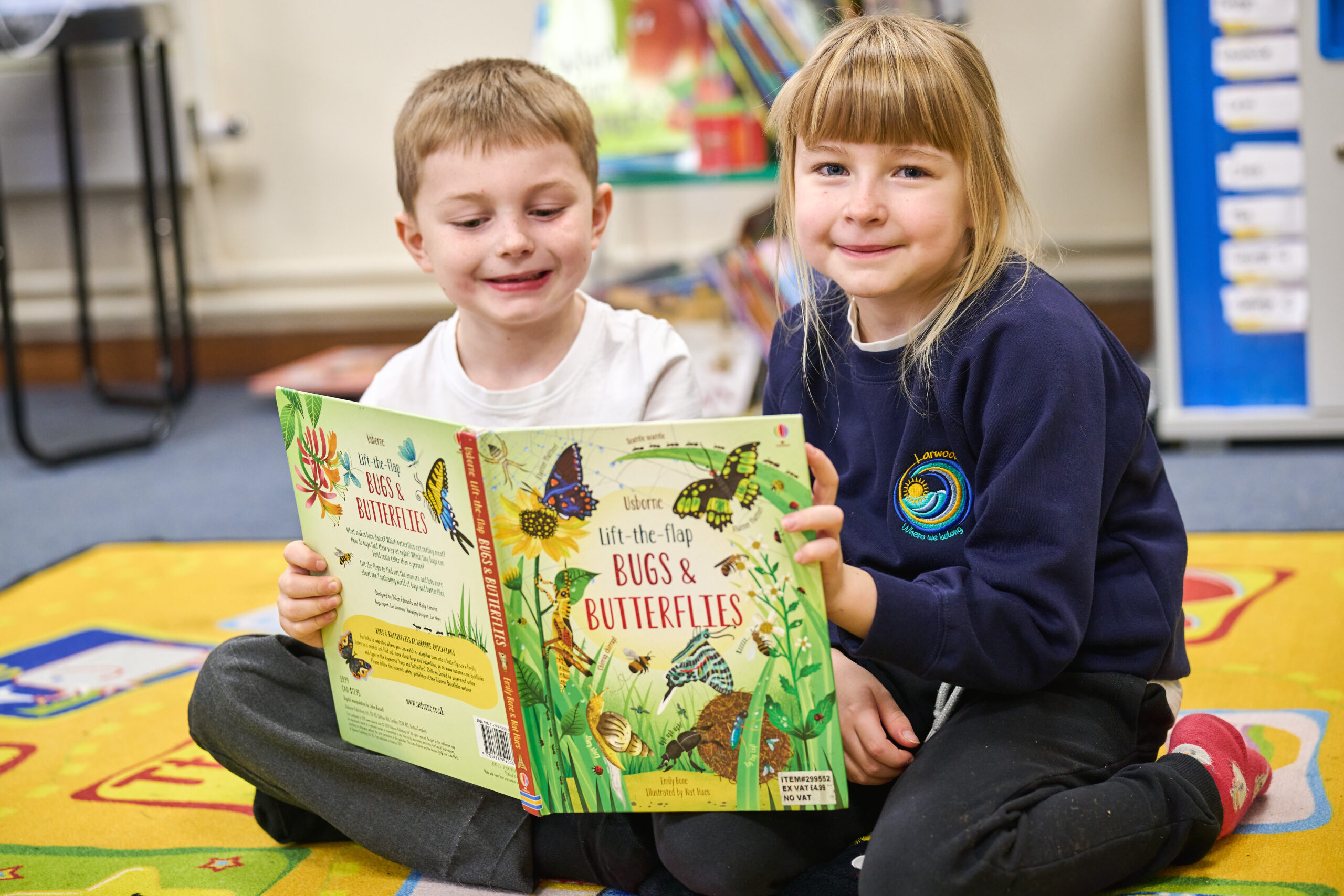
Reading is at the heart of everything we do at Larwood School and forms the foundation of our curriculum. We aim to develop confident, fluent readers who enjoy reading for both pleasure and purpose.
Many of our pupils join Larwood working below age-related expectations, so we prioritise building strong foundations in reading through high-quality phonics teaching, targeted support and a rich reading culture.
We encourage pupils to read widely across fiction and non-fiction texts to develop comprehension, broaden their knowledge and deepen their understanding of themselves and the world around them. Our aim is that every pupil leaves Larwood as a confident reader who can access learning across the curriculum.
Writing
At Larwood School, we are committed to delivering an engaging and ambitious English curriculum that develops articulate speakers, confident readers and inspired writers.
English is embedded across the curriculum and underpins learning in every subject. Through exposure to high-quality texts, rich vocabulary and carefully sequenced learning, pupils develop the skills needed to communicate effectively through speaking, reading and writing.
Our writing curriculum encourages creativity, builds confidence and ensures pupils can write with purpose for a range of audiences.
Implementation
Phonics
We use Twinkl Phonics, a DfE-validated systematic synthetic phonics programme, to teach phonics across EYFS, Key Stage 1 and for pupils in Key Stage 2 who require additional support.
Pupils take part in daily 30-minute phonics sessions taught in carefully organised groups. This allows teaching to be closely matched to pupils’ phonics stages so that learning is targeted and effective.
The programme provides a clear progression through phonics phases, enabling pupils to learn grapheme–phoneme correspondences and apply them confidently in reading and writing.
Pupils who do not pass the Year 1 Phonics Screening Check continue to receive targeted phonics support and take home fully decodable books matched to their phonics level.
For pupils who have not responded successfully to phonics-based approaches, we provide additional support through English Gold, a structured reading intervention programme that develops fluency, vocabulary and comprehension through targeted strategies and high-interest texts.
Reading
We use Twinkl Phonics, a DfE-validated systematic synthetic phonics programme, to teach phonics across EYFS, Key Stage 1 and for pupils in Key Stage 2 who require additional support.
Pupils take part in daily 30-minute phonics sessions taught in carefully organised groups. This allows teaching to be closely matched to pupils’ phonics stages so that learning is targeted and effective.
The programme provides a clear progression through phonics phases, enabling pupils to learn grapheme–phoneme correspondences and apply them confidently in reading and writing.
Pupils who do not pass the Year 1 Phonics Screening Check continue to receive targeted phonics support and take home fully decodable books matched to their phonics level.
For pupils who have not responded successfully to phonics-based approaches, we provide additional support through English Gold, a structured reading intervention programme that develops fluency, vocabulary and comprehension through targeted strategies and high-interest texts.
Daily Reading
Every pupil reads with an adult every day during Essentials sessions. Pupils who require additional support receive extra one-to-one reading sessions or targeted interventions.
Home Reading
At Larwood School we do not set traditional homework. Instead, we prioritise daily reading support within school.
We encourage families to share books at home where possible. Parents and carers may record home reading on Boom Reader, although this is optional. Any additional reading at home helps build confidence and enjoyment.
Class Readers and Library
Teachers read aloud to pupils daily to model fluent reading and promote enjoyment. Pupils also visit the school library regularly to choose books for pleasure.
Reading Culture
We create reading-rich environments in classrooms and promote a love of reading through initiatives such as reading challenges, author visits and World Book Day celebrations.
Writing
We believe that great writers are inspired by great reading. Pupils are immersed in high-quality texts which help them understand vocabulary, structure and style before creating their own writing.
Writing is often linked to engaging topics and experiences, with teachers creating exciting ‘hooks’, such as Stunning Starts and hands-on experiences, to give pupils a meaningful purpose for writing.
At Larwood School we teach writing through Pie Corbett’s Talk for Writing approach, a research-based method that helps pupils internalise language structures and develop confidence as writers.
Through oral storytelling, model texts and story mapping, pupils first learn to imitate language patterns before innovating and creating their own writing. This scaffolded approach supports all learners and helps pupils move from speaking and listening to independent writing.
Pupils write across a wide range of genres including fiction, non-fiction and poetry, developing the skills needed to write for different audiences and purposes.
Grammar and Spelling
Grammar is taught explicitly within English lessons and applied through pupils’ writing. Teachers follow a whole-school grammar progression aligned with the National Curriculum.
Spelling is developed through daily phonics and spelling sessions, including:
- learning year-group common exception words
- revisiting previous spelling rules
- introducing new spelling patterns
- practising through structured activities and dictation
Spelling lists are reviewed regularly and misconceptions are revisited during Essentials sessions.
Impact
Reading
By the time pupils leave Larwood School they are able to read fluently and with understanding, and most importantly develop a love of reading. Pupils can apply their reading skills across the curriculum and engage confidently with a wide range of texts.
Impact is measured through:
- regular phonics and reading assessments
- listening to pupils read and discussing texts
- internal assessments and statutory checks (including the Phonics Screening Check)
- pupil voice and engagement in reading activities
Our approach ensures pupils make strong progress from their starting points and develop confidence, independence and enjoyment in reading.
Writing
Our writing curriculum ensures pupils develop the skills needed to write effectively for a range of purposes and audiences.
By upper Key Stage 2, pupils demonstrate increasing confidence across a range of genres, allowing teaching to focus on creativity, writer’s craft and the accurate use of grammar and punctuation.
Many pupils arrive as reluctant writers but leave Larwood able to write with purpose, meaning and confidence. Through a vocabulary-rich curriculum and high-quality teaching, pupils develop the language and skills needed to succeed in the next stage of their education.