Intent
Reading
Reading is at the heart of everything we do at Larwood School and forms the core of our curriculum. We aim to foster a lifelong love of reading and equip pupils with the skills to read fluently and confidently, both for pleasure and for purpose. Many of our pupils start significantly below age-related expectations, so we prioritise building strong foundations in reading.
We encourage pupils to read widely across fiction and non-fiction to broaden their knowledge, develop comprehension skills, and deepen their understanding of themselves and the world around them. Our goal is for every child to leave Larwood as a confident reader who enjoys reading and can access learning across the curriculum.
Writing
At Larwood, we are committed to delivering an exciting and innovative English curriculum that empowers children to become articulate speakers, inspired writers, and confident readers.
English is not just a discrete subject—it is embedded across the curriculum and underpins all learning. Through high-quality texts, vocabulary-rich environments, and carefully planned progression, pupils experience a creative and continuous English curriculum that develops purposeful writing, effective speaking and listening, and a lifelong love of reading.
Implementation
Reading – Phonics
We use Twinkl Phonics, a DfE-validated systematic synthetic phonics programme, to teach phonics daily across EYFS, KS1, and for pupils in KS2 who need additional support. Twinkl Phonics provides a clear, structured progression through phases, ensuring pupils learn grapheme-phoneme correspondences systematically and apply them in reading and writing.
Children who have not passed the Year 1 Phonics Screening continue to receive targeted phonics support and take home fully decodable books matched to their current phonics phase.
For children who have not responded successfully to phonics-based approaches, we provide additional support through Literacy Gold, a structured reading intervention programme. Literacy Gold focuses on developing comprehension, vocabulary, and fluency skills using high-interest texts and targeted strategies. This approach helps pupils who struggle with decoding to build confidence and understanding, ensuring they continue to make progress in reading and can access the wider curriculum.
Reading Books
We offer a wide range of high-quality texts through book-banded schemes, including Oxford Reading Tree and decodable books aligned with phonics phases. Once pupils reach Phase 6, they begin to select their own books to encourage independence and choice.
Home Reading
Children are expected to read at home at least three times per week. Books are carefully matched to each child’s phonics level or reading ability.
Individual Reading
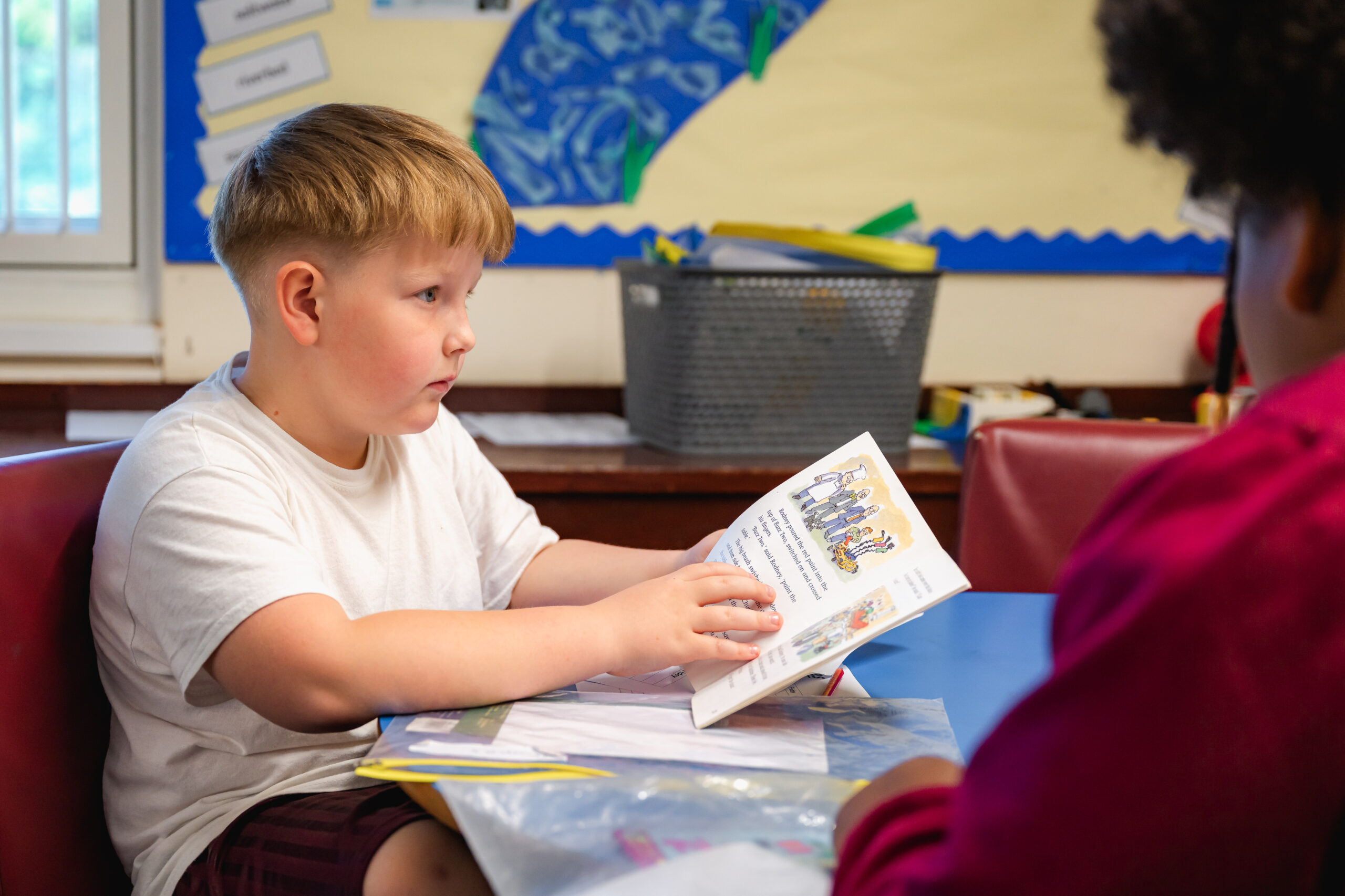
Every child reads daily to an adult during essentials time. Pupils needing extra support receive additional 1:1 sessions or targeted interventions.
Class Readers and Library
Teachers read aloud daily to model fluent reading and promote enjoyment. Pupils also visit the school library weekly to choose books for pleasure.
Reading Culture
We create reading-rich environments in classrooms and run initiatives such as reading challenges, author visits, and World Book Day make reading exciting and meaningful.
Writing
We believe that great writers are inspired by great reading. Pupils are immersed in high-quality texts to understand vocabulary, structure, and style before writing their own pieces. Writing is linked to engaging topics, with teachers creating exciting ‘hooks’ such as Stunning Starters and hands-on experiences to give pupils a real purpose for writing.
At Larwood, we teach writing through Pie Corbett’s Talk for Writing approach, which is a highly effective, research-based method that helps children internalise language structures and develop confidence as writers. This approach begins with oral storytelling and model texts, allowing pupils to imitate language patterns before innovating and creating their own writing. Through activities such as story mapping, shared writing, and guided practice, children build a deep understanding of text structure, vocabulary, and grammar. Talk for Writing supports all learners, including those with additional needs, by providing a clear, scaffolded process that moves from speaking and listening to independent writing, ensuring every child can succeed.
Children write across a range of genres—fiction, non-fiction, and poetry—and for different purposes. They are encouraged to draw on their own ideas and experiences, as well as cross-curricular knowledge, to make their writing meaningful.
Writing – Grammar and Spelling
Grammar is taught explicitly within literacy lessons and applied in writing. Teachers follow a whole-school grammar progression based on National Curriculum expectations.
Spelling is a strong focus across the school. Daily phonics sessions and spelling activities include:
- Learning year-group common exception words
- Revisiting previous spelling rules
- Introducing new patterns
- Practising through activities and daily dictation
Spelling lists are tested weekly, and any errors are revisited during essentials catch-up sessions. Pupils are encouraged to apply spelling rules consistently in their writing.
Impact
Reading
By the time pupils leave Larwood, they are able to read widely and often, with fluency and comprehension appropriate to their age, and most importantly, with a love of reading. They can apply their skills to access learning across the curriculum and engage with a diverse range of texts.
Impact is measured through:
- Regular phonics and fluency assessments
- Listening to pupils read and discussing texts
- Internal assessments and statutory checks (e.g., Phonics Screening)
- Pupil voice and engagement in reading activities
Our approach ensures pupils make strong progress from their starting points and develop confidence, enjoyment, and independence in reading.
Writing
Our writing curriculum ensures pupils make sustained progress and develop transferable skills. By upper Key Stage 2, most pupils are confident with a wide range of genres, allowing teaching to focus on creativity, writer’s craft, and mastery of grammar and punctuation.
As a result of high-quality teaching and vocabulary-rich experiences, pupils achieve well—evident in internal assessments, book scrutiny, and pupil voice. Many pupils start as reluctant writers but leave Larwood able to write with meaning, purpose, and confidence.
Children leave with an enriched vocabulary, a passion for writing, and high aspirations to continue developing their skills throughout their education.